Food and drink / Seafood traditions
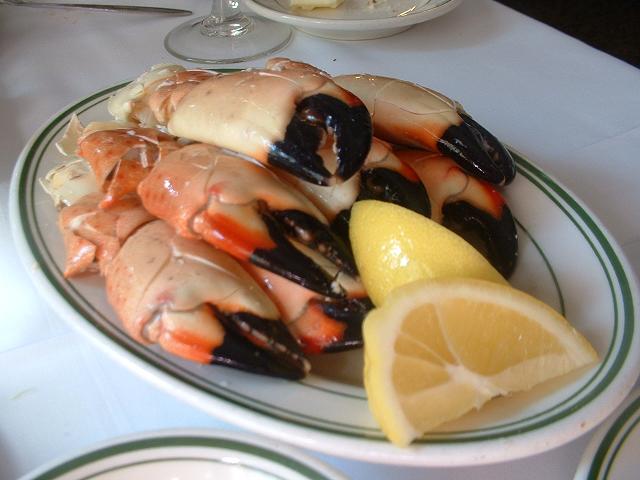
Stone crab claws are a prepared seafood associated with Miami Beach dining and the wider Florida seafood trade. They are commonly presented in their shells, often chilled with mustard sauce. Their restaurant setting connects Joe’s Stone Crab with fishing and processing elsewhere in southern Florida, rather than making the city the sole source of the catch.[1][3]
The prepared claw§
Florida’s agriculture department describes cooking claws after harvest and selling them fresh-cooked or frozen. Its culinary account distinguishes cold claws with mustard dipping sauce from a hot presentation with drawn butter and lime. The claw can be served with shell remaining around the meat, while picked meat has uses in other dishes. Those formats describe a food product and its preparation, rather than one restaurant’s exclusive recipe.[1]
Regional trade before the plate§
Theresa Bert, Richard Warner and Lorin Kessler’s October 1978 Florida Sea Grant paper places the growth of the industry within a wider southwest Florida fishery. Its historical discussion describes an earlier local market and shipments of whole crabs to Miami, followed by a broader restaurant trade in large cities. These are the paper’s retrospective commercial accounts, not a claim that one establishment invented eating the animal.[2]
The same study distinguishes small operators who cooked and froze claws themselves from those selling to processing houses, retail markets or restaurants. That distinction places cooking, storage and sale at several possible points between a fishing boat and a meal. The 1978 descriptions do not establish the current supplier of any particular restaurant.[2]
A dated Miami Beach kitchen account§
WSVN’s October 16, 2025 written report follows a shipment from Marathon to Joe’s Stone Crab and the staff preparing for the dining room. Executive chef Jim Pastor described boiling the claws and serving the restaurant’s mustard sauce. The report observed a busy dining room, but its expected first-night quantity was a forecast, not a confirmed sales total. This kitchen account links the Keys with South Beach through a specific reported delivery.[3]
Sauce and the larger meal§
Former Chef’s October 2013 published adaptation combines dry mustard and mayonnaise with Worcestershire sauce, dairy, lemon and cayenne. It is explicitly described as adapted from Joe’s sauce, rather than an inspected original restaurant formula. Its suggested meal adds hashed-brown potatoes, creamed spinach, coleslaw and key lime pie, showing the claws within a sequence of accompaniments and dessert.[4]
The contrast between the agriculture department’s hot and cold presentations and the named mustard-sauce adaptation shows that the prepared ingredient has several serving formats. The food’s local restaurant associations should therefore be read alongside its broader processing and cooking history.[1]
Sources & references
- Stone crab: culinary formats Florida Department of Agriculture and Consumer Services. Retrieved . ↑1↑2↑3
- Stone-crab fishery, October 1978, selected pages Florida Sea Grant / Bert, Warner and Kessler. Retrieved . ↑1↑2
- Opening-night kitchen report, October 2025 WSVN / Jessica Vallejo, Matthew Garcia and Sebastian Cuervo. Retrieved . ↑1↑2
- Mustard-sauce adaptation, October 2013 Former Chef. Retrieved . ↑