Neighborhoods / Culture
Little Havana is a neighborhood of Miami strongly associated with Cuban migration and cultural life. University of Miami Libraries describes its transformation in the early 1960s by Cuban exiles and immigrants from other Latin American countries. Its history includes the earlier Riverside area as well as the communities that gave the neighborhood its later name.[1][2]
Riverside before Little Havana§
The university's chronology places subdivisions west of downtown in the early twentieth century, including Riverside and the Lawrence Estate Land Company subdivision. It describes houses and bungalows, followed by transport connections that supported growth. A bridge opened in 1905, and a Flagler Street trolley began operating in 1915. The present neighborhood occupies a landscape shaped before its familiar name came into use.[2]
Eighth Street also appears in that early history. The chronology records construction beginning in 1915 and associates its later identity with Calle Ocho. The street is therefore both part of a longer network of urban development and a name closely associated with the neighborhood's Cuban history.[2]
Migration and neighborhood identity§
A county planning report identifies Cuban exile settlement in the 1960s and later arrivals from Nicaragua, Honduras and other Central American countries during the 1980s and 1990s. Its account places these successive migrations within a neighborhood already established before the Cuban Revolution. The name Little Havana reflects an important Cuban association, while the report also records a more varied Latin American community. Those histories overlap without making every resident's experience the same.[3]
The Freedom Tower provides context beyond the neighborhood itself. Located downtown, it served as the Cuban Refugee Center from 1962 to 1974. Miami Dade College's institutional history describes a place where assistance and resettlement intersected with the wider transformation of the city. The tower is a related landmark, not a building that needs to be relocated into Little Havana to explain the neighborhood's history.[4]
Cultural buildings and public places§
Tower Theater is a landmark of the neighborhood's cinema history. Miami Dade College records that it first opened in December 1926, showing the silent romantic comedy The Palm Beach Girl. The cinema was already part of the area's built landscape before the later migration that gave Little Havana its familiar name.[5]
Another example of reuse is the Manuel Artime Community Center and Theater. The congregation's own historical account records the city's purchase of the former Riverside Baptist Church building in 1975. A building associated with an earlier congregation became a community cultural facility as the surrounding area changed.[6]
The city's Domino Park provides domino and chess facilities.[7]
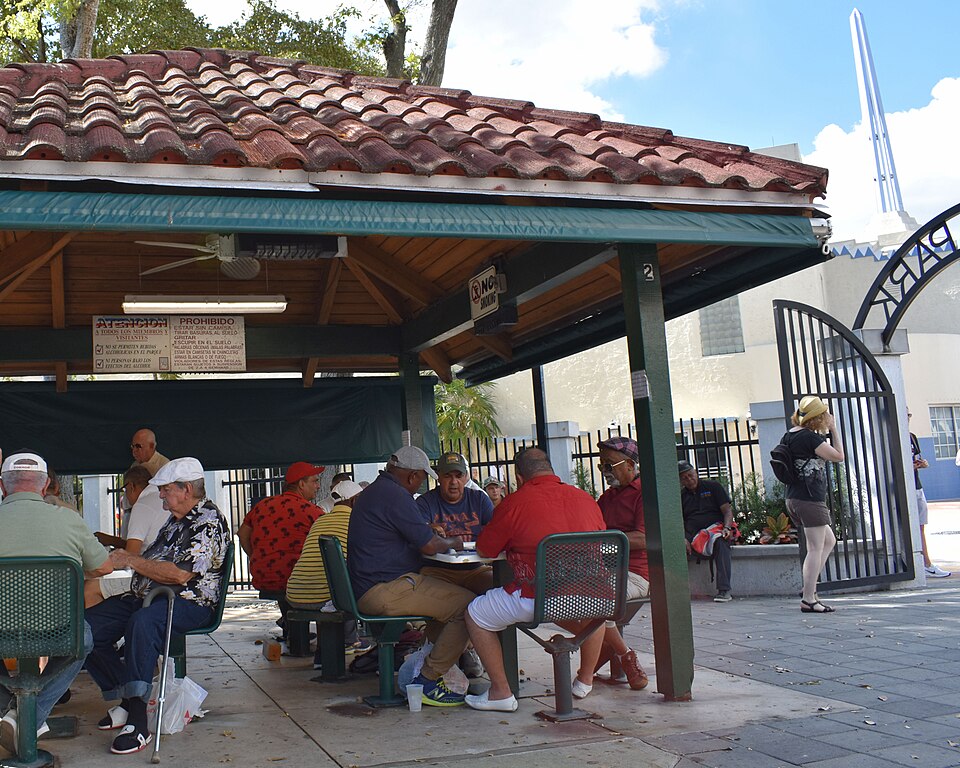

Food and neighborhood gathering§
Food connects the neighborhood's street life to wider Cuban Miami. The Greater Miami Convention & Visitors Bureau's Calle Ocho guide describes Cuban sandwiches at Versailles and Sanguich, shared colada at La Colada Gourmet and guava-based ice cream at Azucar. These are examples of different kinds of food business, rather than a ranking of their quality.[8]
Coffee windows also appear in local cultural documentation. O, Miami's Ventanitas project, credited to Daniela Perez Miron and photographer Gesi Schilling, uses poetry, photographs and interviews to examine conversation around these windows. Its published description and foreword distinguish everyday takeaway service from settings for political, family and social discussion. This offers context for Cuban coffee and pastelitos, without making every customer's experience or every window the same.[9]
Community history§
The University of Miami's Little Havana collection includes interviews as well as a chronology. Such records make it possible to examine individual experiences alongside an outline of streets, buildings and migration. Like Coconut Grove, Little Havana is a neighborhood whose local history adds detail to the broader history of Miami; neither can be represented fully by a single landmark or a single moment of arrival.[1]
Sources & references
- IPH Communities – Little Havana University of Miami Libraries, Institute for Public History. Retrieved . ↑1↑2
- IPH Communities – Little Havana Chronology University of Miami Libraries, Institute for Public History. Retrieved . ↑1↑2↑3
- Little Havana Community Background Report, p.1 Miami-Dade Metropolitan Planning Organization / FIU archive. Retrieved . ↑
- About the Freedom Tower Miami Dade College. Retrieved . ↑
- Miami Dade College Resumes Management and Operation of Tower Theater Miami on Nov. 1 Miami Dade College. Retrieved . ↑
- Who We Are — Our History Riverside Baptist Church. Retrieved . ↑
- Domino Park City of Miami. Retrieved . ↑
- Explore Calle Ocho in Little Havana Greater Miami Convention & Visitors Bureau. Retrieved . ↑
- Ventanitas: A Window into Miami’s Coffee Culture O, Miami. Retrieved . ↑