Miami-Dade cultural places / Historic landscapes and performance
The Kampong is a botanical garden and historic estate in Coconut Grove, associated with plant explorer David Fairchild. It is one of the National Tropical Botanical Garden's sites and the setting for a partnership with Florida International University in tropical plant research, education and training. The garden, historic buildings and university research center have related but distinct roles.[1]
From plant collection to institutional garden§
An institutional account dates Fairchild's purchase and naming of The Kampong to 1916. It traces the garden's later teaching role through visiting botanists Richard A. Howard and P. Barry Tomlinson, whose work developed an immersive course in plant taxonomy, anatomy and morphology. Catherine Sweeney subsequently supported that use of the living collections for botanical education.[2]
The Cultural Landscape Foundation dates the Fairchild house and compound designed by Edward Clarence Dean to 1928. Its history identifies Sweeney's acquisition in 1963 and her 1984 gift to the organization now known as the National Tropical Botanical Garden. Those stages distinguish an individual plant collector's residence from the later institutional garden.[3]
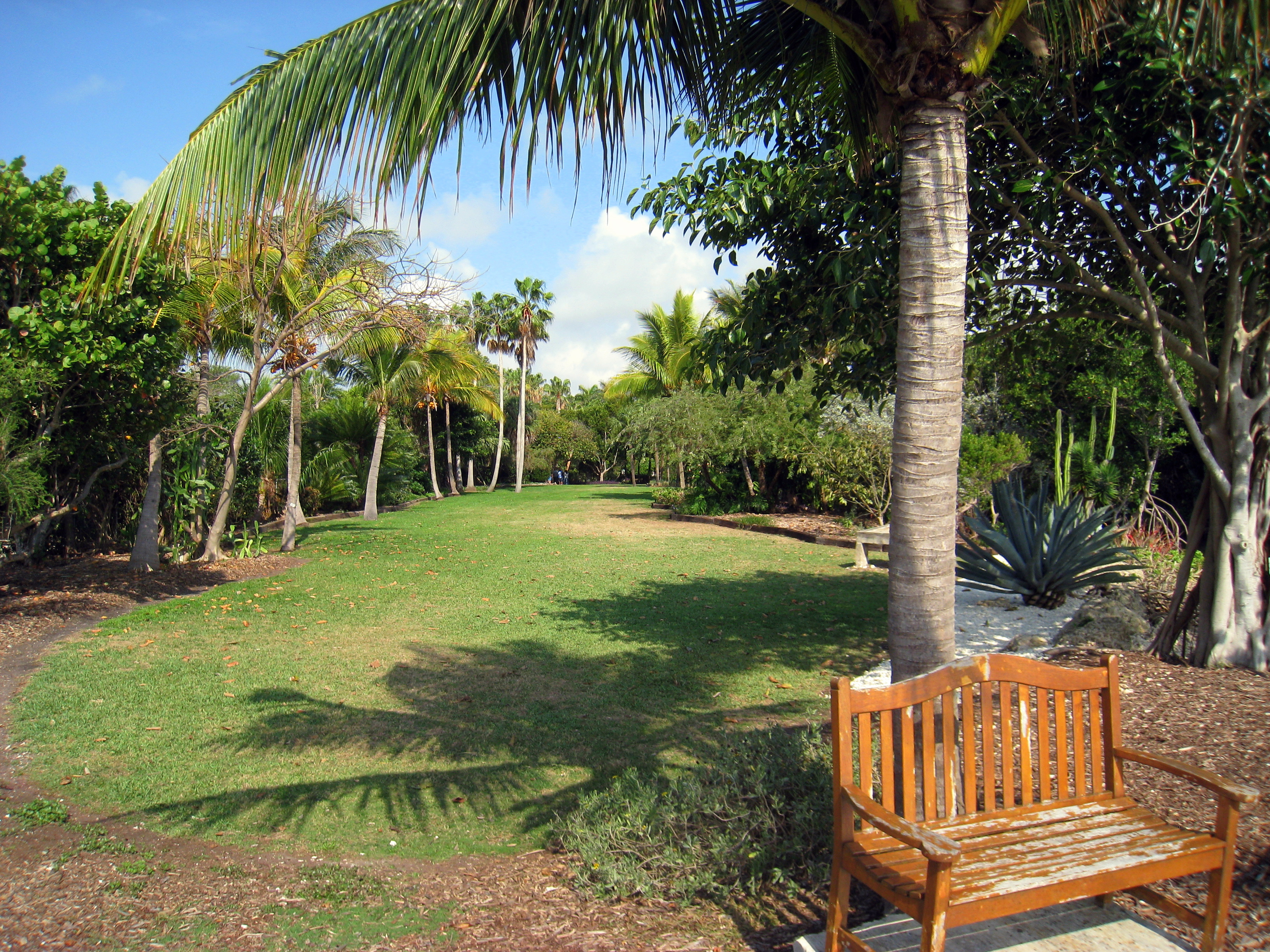


Landscape and living collections§
The foundation describes a landscape oriented toward Biscayne Bay, with a lawn framed by trees, carved gates, limestone paths and coral-stone walls. Small groupings of plants coexist with the bay-facing open space. Mangroves and canopy trees help separate the garden from its urban surroundings. This arrangement links a designed landscape with the coastal setting rather than presenting the property simply as a display of isolated specimens.[3]
Mike Clary's August 2025 reporting describes a project in which Miami Dade College students took scions from aging avocado and mango trees and grafted them onto rootstock. The project, explained by landscape-technology professor Theresa Chormanski, sought to preserve historical varieties. It illustrates the work required to maintain a living collection, whose plants can age and decline.[4]
Research and teaching§
FIU describes the International Center for Tropical Botany as a partnership with NTBG, bringing together researchers working across tropical regions. Its educational mission sits alongside the garden's historical identity, not in place of it. The center is part of FIU's Institute of Environment, while the garden remains identified as an NTBG site.[1]
NTBG's October 2023 course account describes morning lectures, collection of plant material at The Kampong and nearby gardens, and afternoon work in laboratories on identification, morphology and anatomy. Fairchild Tropical Botanic Garden was among the other collecting locations. The report documents a particular teaching season and collaboration, rather than merging those separate gardens into one institution.[2]
Art and public interpretation§
An institutional listing advertises Meg Wallace's Out of Darkness: The Ecology of Care for September 2026 through September 2027 in the Galt Simmons Room. It describes field research and filming in mangrove environments and a short film, Whispers Beneath the Canopy. The listing connects contemporary interpretation with the garden's coastal environment; it is an advertised exhibition record, not an independent visit report.[5]
The exhibition listing publishes the garden address as 4013 South Douglas Road.[5]
A layered food-forest demonstration§
At the Coconut Grove site, NTBG's December 2024 retrospective records work on a food-forest design project at The Kampong. David Bryant's April 2025 institutional account describes the resulting Food Forest exhibit as combining edible fruit trees with an understory of perennial herbs, greens and vegetables. He reports that harvests were donated to local food pantries and the community.[6][7][3]
Operations manager Nina Jungman explained the planting approach as copying a natural forest's structure with edible plants at different levels. The same account describes collaboration with the International Center for Tropical Botany on culturally significant crops, including Haitian basket vine. Its separate aspirations for container gardening remained proposals, distinct from the described exhibit.[7]
Sources & references
- Kampong: university research partnership FIU Institute of Environment. Retrieved . ↑1↑2
- Kampong botanical teaching, October 6, 2023 National Tropical Botanical Garden / Jon Letman. Retrieved . ↑1↑2↑3
- Kampong: landscape history and design The Cultural Landscape Foundation. Retrieved . ↑1↑2↑3↑4
- Kampong reporting, August 28, 2025 Coconut Grove Spotlight / Mike Clary. Retrieved . ↑
- Kampong: dated mangrove exhibition listing National Tropical Botanical Garden. Retrieved . ↑1↑2↑3
- Plant Wins of2024 National Tropical Botanical Garden / Jon Letman. Retrieved . ↑
- It takes a forest, April15,2025 National Tropical Botanical Garden / David Bryant. Retrieved . ↑1↑2